
The Shift That Changes Everything Start Asking What’s Next
Strength is not getting it right. It’s choosing what’s next.
If there is one thing men are taught to fear, it is not knowing what to do next. We grow up believing we need a plan, a fix, a direction, a blueprint. We are supposed to act with certainty, even when we have none. And when we don’t? Shame shows up immediately and tells us that we are the problem.
In my work, this comes up all the time. A dude feels overwhelmed around food, how much they ate, or discouraged about his body, and the first thought sounds like, “I screwed up again. Why do I always do this?” Or, “I should know better by now.” Or, even something much worse and much less kind. These reflexive thoughts convince us that something is wrong with us, not with the systems and expectations we’ve inherited.
But here’s the thing. That first thought is rarely the truth. It is a habit. A leftover. A survival strategy.
It is diet culture’s voice.
It is the eating disorder’s voice.
It is the perfectionist voice.
It is the voice of every message telling men to control, correct, and perform rather than feel.
And that voice might show up for a long time. We do not unlearn decades of messaging overnight. You may never fully silence it. That is not failure. That is being human.
The real work is not about erasing that first thought.
The real work is what comes next.
This is where “What’s next?” becomes so powerful.
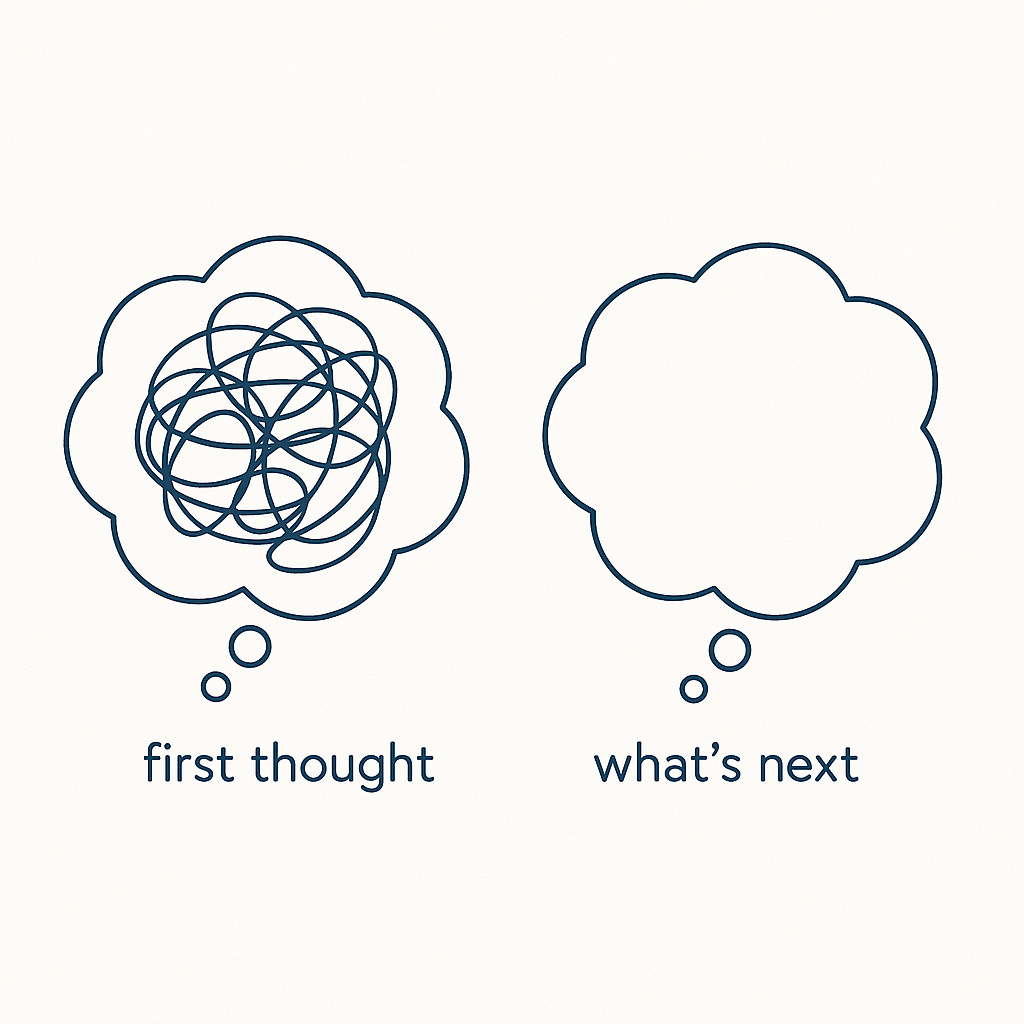
The Myth of the Perfect First Thought
If find it so common how people I work with believe healing means having the “right reaction” every time. They think they should reach a point where the negative thought never appears again, where the old stories disappear, and where a difficult moment is met instantly with wisdom. But this is just another example of how diet culture and perfectionism show up, even in our healing.
That is not how the brain works. If the first thought comes from years of conditioning, the next thought is where your agency lives.
First thought: That meal was too much.
Next thought: Or maybe that was exactly what my body needed.
First thought: I feel uncomfortable in my body. Something must be wrong.
Next thought: Discomfort is not a sign of failure. It is a sign of being alive.
First thought: I should be doing better.
Next thought: I am already doing the best I can in this moment.
You do not have to control the first thing that shows up.
But you can shape the next thing that follows.
Men and the Fear of Unscripted Moments
Most of us were never taught to tolerate uncertainty. We were told to get it right, solve the problem, tighten up, push through. From the outside, this looks like strength. On the inside, it’s exhausting and blocks vulnerability, curiosity and growth.
And here is where The West Wing sneaks into this work. (Because, of course, it does.) President Bartlet always said, “What’s next?” It wasn’t just about moving on; it was also steadying himself, resetting, and moving forward. I wrote about that idea before, but lately I’ve been thinking about it as something even more subtle. Not as a dramatic moment, but as a quiet interruption to the cultural script telling men they must be flawless.
“What’s next?” gives us permission to stop performing certainty and start practicing curiosity instead.
When you think you have to get it right immediately, every small misstep feels enormous. You spiral. You shut down. You give up.
“What’s next?” breaks that spiral. It gives us a moment to breathe and take a beat so that we can be curious about the next thought instead of being owned by the first one.
This question does not require you to be wise. It just requires you to stay open to “What’s next?”
Small Next Steps Matter More Than Big Plans
People imagine “What’s next?” leads to huge insights or grand declarations. It doesn’t. It won’t. It will do something much smaller.
What’s next might be drinking some water.
Or texting a friend.
Or eating the rest of your lunch.
Or reminding yourself that discomfort is not danger.
Or choosing a kinder sentence in your head.
Or simply deciding not to abandon yourself for the rest of the day.
But here’s the thing, small steps are how people actually heal, not by achieving emotional perfection, but by shifting what happens after the reflexive thought. By practicing, “What’s next?”
Your Turn
If the first thought is a reflex, the next thought can be a choice.
If the first thought is survival, the next thought can be compassion.
If the first thought is old conditioning, the next thought can be you.
So I want to leave you with this:
Where in your life do you feel frustrated by your first thoughts? What might happen if you stopped trying to eliminate them and started shaping the next ones instead?
How would it feel to treat “What’s next?” as a path rather than a performance?
In Part 2, I’ll share how this question became a lifeline for me this year, especially in moments I didn’t choose or expect. For now, I hope you can notice the power that comes from pausing and to be curious about, “What’s next?”
Beautiful! How freeing!